 There was a time when I thought that in order to have a great relationship, two people must have a lot in common with each other. I sought out guys who had the same interests as I did - who were passionate about art and music, who could quote Shakespeare and tell me about the Tokyo Imperial Palace, and who could talk about books and politics until the wee hours of the morning. And when I found them, I always wondered what was missing.
 Then -- and ironically -- when A. and I were already engaged and I was having a panic attack and frantically thinking of running away to Rome a la Audrey Hepburn (I was very specific about Rome and there had to be a scooter), I had a "duh" moment. One of those moments when you realize something that, in retrospect, seems as obvious as the nose on your face, but at the time is a huge epiphany. I realized that our differences are what makes us such a strong couple. It just works for us, it's uniquely our own. It doesn't matter that I like French chanson and he likes Metallica, that I could spend a whole day walking around Paris and he prefers to lay on the beach in Hawaii or that he reads modern Japanese literature and I love Henry James. We have the important things -- the really important things -- in common, and we are better and happier as a team than we are on our own. And, as A. put it (gently and patiently enough to chill me out - in other words, using the tone of a SWAT team negotiator trying to disarm a crazy person with a time bomb), we have our love in common. What can I say, we have our romantic moments too.
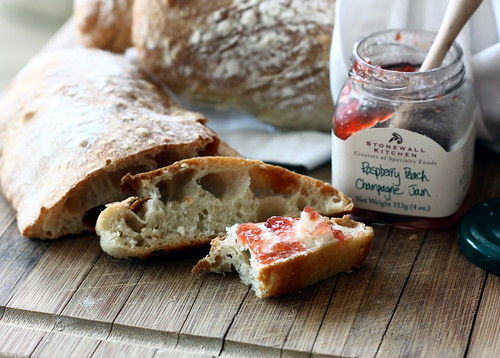
As you can see, I didn't run away to Rome. And I can even accept our differences with a sense of humor now, like him eating the baguette warm from the oven, breaking the golden crust with a crunch heard in the next room, and me wanting to wait until it cools completely and slather it with butter and jam. God, I am so patient with his little quirks, no? ;)
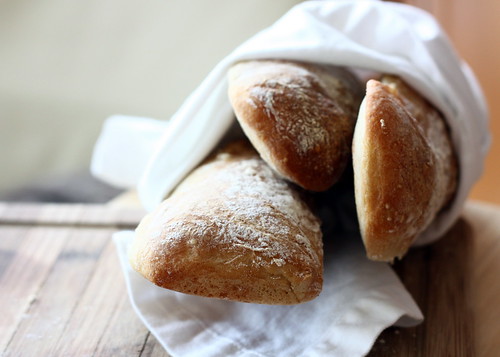
This recipe comes by way of Jude at Apple Pie, Patis, & Pate - a blog that I've been reading with great pleasure. Thanks to him, I understand why these baguettes came out a bit flatter than I anticipated. Apparently, I used the wrong flour that was too soft to help the dough firm up properly. Since I'm so new to this whole baking-with-yeast thing, I didn't realize that my usual General Mills flour wasn't going to cut it. Next time, I'm definitely using King Arthur. Oh, and by the way, there will definitely be a next time. These baguettes were wonderful. The crust was a lovely deep shade, and crunchy too, hiding chewy soft insides with those beautiful irregular air pockets we all know and love. The labor was pretty minimal (except the soft flour and sticky dough, ugh) and I cannot wait to make it again. Thanks, Jude, for the recipe and for being so kind to answer my panicky emails with questions (omg, my dough is sticky, help! what do you mean, the flour is "too soft"??? aaaah!).
Pain à l’ancienne Baguettes
makes four 12- to 16-inch baguettes
Ingredients:
unbleached all-purpose flour: 4 cups/17.6 oz/500 g
water, ice cold: 1 cup + 6 tbsp/11.5 oz/325 g
water: 3 tbsp + 1 tsp/1.8 oz/50 g
salt: 1.5 tsp/.3 oz/9 g
instant yeast: 1.5 tsp/.2 oz/5g
Notes:
* Best to use King Arthur all-purpose flour or another flour with a higher protein content than regular supermarket all-purpose flour.
* Peter Reinhart’s pain à l’ancienne in The Bread Baker’s Apprentice is based on a method very similar to this recipe. In Reinhart’s version, the salt and yeast are added before refrigeration.
Directions:
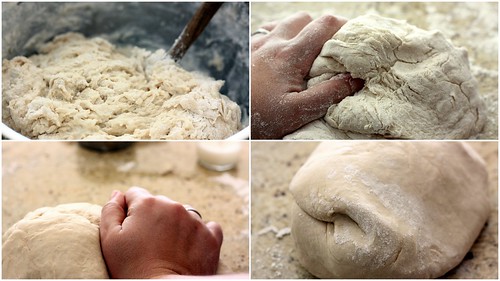
Mix together the flour and the ice-cold water until a shaggy ball of dough is formed.
Knead 4 to 6 minutes, until the flour is thoroughly hydrated and a smooth ball of dough is formed.
Cover with plastic wrap or store in an airtight container. Refrigerate for at least 8 hours and up to 2 days. The bread will be sweeter the longer the dough rests (this process of resting the dough before adding yeast is called autolyse).
Add the additional water, salt, and instant yeast to the cold dough. Knead until the water is completely absorbed, about 6 to 10 minutes. The dough will be very sticky.
The dough will initially have the consistency of chewing gum and will not readily absorb the additional water.
Ferment #1 90 minutes at room temperature
Using gravity and a bench scraper to help you, lift the dough to stretch it into a long rectangle and put it back on the counter with the short side facing you. The fold it into thirds vertically, like an envelope, and then fold again horizontally.
Ferment #2 90 minutes at room temperature
Stretch and fold again.
Ferment #3 2 to 3 hours at room temperature, or until almost doubled
in size
Preheat Oven 460ºF / 240ºC
Divide 4 equal pieces using a lightly moistened bench scraper
Preshape: On a lightly floured surface, gently shape each piece
into loose ovals by tucking the sides underneath the
pieces of dough. Handle as gently as possible to avoid
degassing.
Pain à l'ancienne French Baguettes Shaping
Rest: 10 minutes
Shape: Stretch gently into strips, about 12 to 16 inches long.
Steam: 1 cup of boiling water poured in a heavy steam pan
(preferably cast iron)
Bake: Bake for 8 to 9 minutes at 460ºF / 240ºC. Rotate the
loaves and bake for another 10 to 15 minutes, until the
crust is deeply browned. The thickest part of the
baguette will register 205ºF / 91ºC when done.
Cool: At least 30 minutes